The new generation of industrial hot gas engines

„We cannot solve our problems with the same thinking we used when we created them.“ (A. Einstein)

From the Stirling engine to the Heat2Power Engine – The revolution of the externally heated high-performance heat engine for utilizing industrial waste heat and power generation during periods of low wind and solar output is based on a fundamentally restructured process that differs significantly from the classic Stirling principle.

  • Instead of idealized isothermal state changes, a realistic, continuously operated system architecture with clearly defined work cycles is used.
  • Expansion, compression, heat absorption and release no longer occur successively within a single unit, but are distributed across specialized components – and take place at different times, but continuously within the system.
  • The Heat2Power Engine operates with discontinuous filling and emptying of the cylinders. During expansion and compression, the cylinders are sealed, and the pressure changes do not propagate into downstream pipes as they do in a conventional machine. Dead spaces are completely eliminated.
  • Unlike conventional machines, there is no oscillating flow between the hot and cold sides. The Heat2Power Engine uses a continuously operating cycle.
  • The thermodynamic changes of state approach the ideal process much more closely than in classical Stirling engines.

The result: High power density, excellent efficiency – based on a strikingly simple mechanical design.

System architecture of the Heat2Power engine

Multi-cylinder system

In classic Stirling engines, a hot cylinder is coupled to a cold cylinder. The Heat2Power Engine is a multi-cylinder engine; the number of cylinders is scalable according to the power requirement, with 12 hot/cold cylinder pairs being conceivable.

The cylinders are arranged linearly in a boxer configuration and connected by a Hypocycloid linear guidanceopen in new window . For every hot working cylinder, there exists a cold compression cylinder.
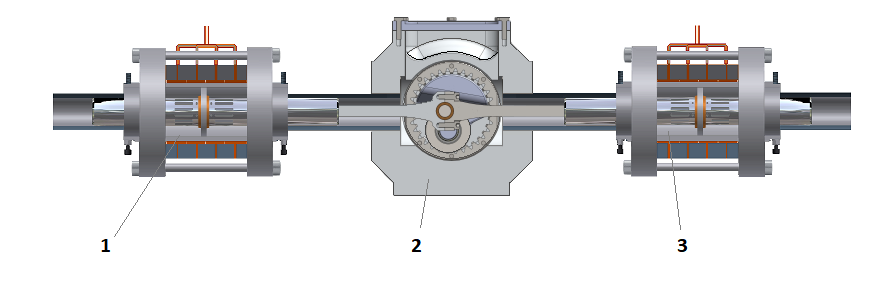
Cylinder pair with hypocycloid gearbox

1 = Expansion cylinder
2 = Hypocycloid gearboxopen in new window , alternatively: Crankshaft with axial guidance of the piston rods
3 = Compression cylinder

Central recuperator

Classic Stirling engines use a separate regenerator for each pair of cylinders. The Heat2Power-Engine uses a central recuperator for all cylinder pairs instead.
  • The hot and cold gas flows from the cylinders are each collected in a separate line. The two separate piping systems carry the hot and cold gas through separate areas (tube chamber and jacket chamber) of the regenerator.
  • This results in a quasi-continuous gas flow and concentrated counterflow heat regeneration – continuously and simultaneously for all cylinders.
  • The continuous counterflow heat exchange results in a permanently hot and a permanently cold side – with a stable temperature profile. The regenerator thus always maintains working gas in a suitable condition.
  • The volume of the regenerator significantly exceeds that of a cylinder chamber. Therefore, the gas requires several operating cycles to flow through completely – resulting in a long residence time and thus high heat exchange efficiency.

Closed circuit with stable flow guidance

  • The expanded gas from the working cylinders flows through the regenerator via the low-pressure system to the compression side.
  • After compression, the gas is returned through the same regenerator via the high-pressure system, then to the heater and into the working cylinders.
  • The cyclically staggered operation creates a quasi-continuous flow through the regenerator with a permanently effective temperature gradient.
Configuration of the new Heat2Power installation

Cylinder design and mechanical structure

A flat, symmetrical, double-acting piston divides the cylinder into two chambers with equal displacement volume. The piston rod runs through the cylinder and is supported on both sides of the cylinder by guide sleeves on the outside.
  • Working cylinder: one chamber expands hot gas, the other empties it.
  • The expansion in the working cylinder drives the compression cylinders, which are connected by a Hypocycloid linear guidanceopen in new window .
  • Compression cylinder: one chamber draws in cold gas, the other compresses it.
After half a crankshaft revolution (one full stroke), the two chambers in a cylinder switch their function. Therefore, there are two complete power strokes per cylinder pair per revolution.

cylinder outside view
Piston Piston Rod Cylinder Head left Cylinder Head right Anular high pressure chamber left Anular high pressure chamber right Heat Transfer Elements Heat Transfer Elements Heat Insulation Heat Insulation Anular Ring Elements (Casing) Anular Ring Elements (Casing) Expansion bolts Expansion bolts Guiding Sleeve (Low pressure pipe side) Heat Piping Piston Rod Piston Rod Piston Rod Guiding Sleeve (Low pressure pipe side) Guiding Sleeve (Low pressure pipe side) Guiding Sleeve (Crankshaft side) Guiding Sleeve (Crankshaft side) Cylinder Wall (exchangeable liner) Cylinder Wall (exchangeable liner) High Pressure Inlet (Left Chamber) High Pressure Inlet (Right Chamber) Left Cylinder Chamber Left Cylinder Chamber Right Cylinder Chamber Right Cylinder Chamber
cylinder interior view

High-pressure chambers

The cylinder heads contain ring-shaped high-pressure chambers, which serve to fill the working cylinders and to empty the compression cylinders.

Piston Rod



The hollow piston rods are an integral part of the piping system and enable controlled gas flow through ports and bores. They serve as flow channels in the low-pressure system, with their diameter determined by the required flow velocities. Depending on the piston position, the ports and bores establish connections to the cylinder chamber – for emptying in working cylinders and for filling in compression cylinders.

Mechanical guidance

The piston rods are guided outside the cylinder in sleeves that extend beyond the cylinder heads. Linear guide systems such as Hypocycloid linear guidanceopen in new window are used to avoid lateral forces. Piston rings (if present) do not serve for axial guidance or sealing.

Piston

The flat piston is in contact with the cylinder wall only via a single sealing ring – reducing friction and allowing for a possible gap. Gas loss can only occur through overflow within the same cylinder.

Flow Guidance Within the Cylinders

Each double-acting cylinder contains two chambers, one of which is actively connected to the piping system during the stroke – either for expansion or compression, or for emptying or filling.

The corresponding inlet and outlet channels are opened and closed by an extremely simple internal mechanism. This ensures that the flow paths are only opened or closed at defined dead centers – without external valves or complex controls.

Show more technical details

The graphic shown represents one possible implementation variant and serves to illustrate the flow guidance.


Expansion cylinder with gas flow through the piston rod
Expansion in the right cylinder chamber pushes the piston to the left. Expanded gas is expelled from the left chamber.
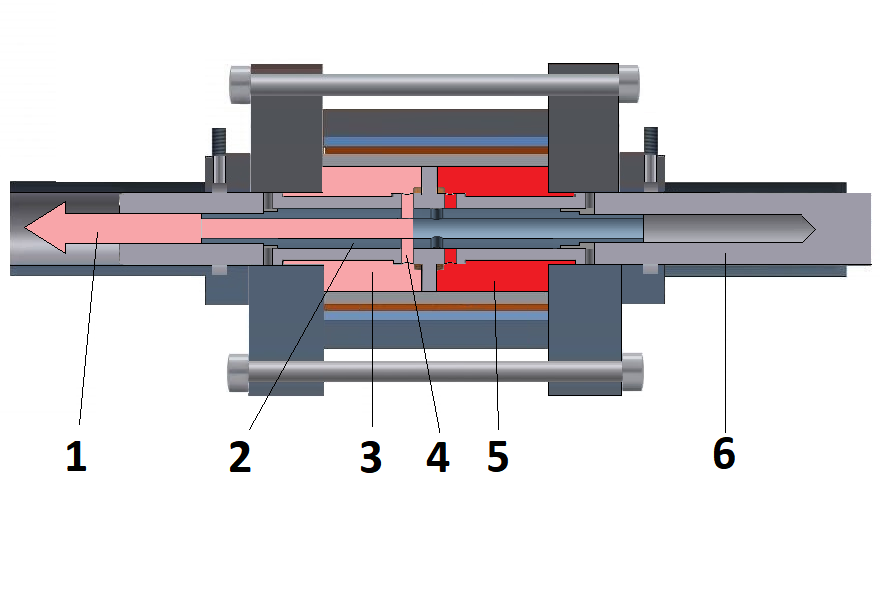
1 = Expelling gas, 2 = Control piston in left end position, 3 = Expanded gas (here: in left cylinder chamber), 4 = Open exhaust port, 5 = Expanding gas (here: in right cylinder chamber), 6 = Piston rod

Regeneration and circulatory system

The Heat2Power Engine utilizes a central regenerator for heat recovery – designed as a counterflow tube bundle heat exchanger with a permanently stable temperature distribution. The cyclically offset gas flow enables continuous regeneration without feedback losses.

Flow guidance and cooling

  • Cooling devices in the low-pressure system enable targeted cooling of the working gas before compression.
  • Gas flow is discontinuous and synchronized – without valves, camshafts, or complex control mechanisms.
  • Switching devices at the dead centers enable targeted filling and emptying.
  • The high-pressure system connects the compression outlet to the working inlet; the low-pressure system connects the working outlet to the compression inlet.

Animation System showing the flow paths


Heat2Power-Engine - System showing the flow paths


Flow switching – variants and principles

The switching of the flow paths between the cylinder chambers and the piping system is achieved by an internal mechanism that is automatically activated at the dead centers. One chamber opens while the other remains closed – synchronized with the piston movement.

Several design principles are available, including

  • pressure-controlled switching
  • mechanically coupled switching
  • magnetically assisted switching
  • .
All aim to release the flow precisely at the reversal points, without external valves or complex controls.

FAQ - Pressure-controlled switching
  • [Question]: Why not simply use pressure relief valves to empty the chambers of the compression cylinders? [Answer]:
    • Compression and discharge are clearly separated.
    • Pressure relief valves can only release peak pressures into a lower-pressure chamber. The pressure level in the compression cylinders is generally lower than in the working cylinders! Discharge therefore may occur into a higher-pressure chamber, as the highest pressure is only reached after heating in the heater.
    • It must be ensured that a defined quantity of gas is discharged at a defined pressure at a specific piston position, regardless of the conditions in the downstream pipelines. The Heat2Power engine technology ensures that the cylinder chambers are emptied as completely as possible. During the return stroke, the cylinder chamber should be completely refilled, not just partially.
    • The small amount of gas remaining in the cylinder after discharge is further compressed and serves as a gas buffer to reduce inertial forces during the change of direction at the dead center.
    • This small remaining volume of gas experiences the highest compression, and therefore also the highest heating. This can be effectively cooled by additional cooling of the cylinder heads (large surface area, small thickness). During cylinder inversion, this gas expands again, resulting in an even lower temperature in the compression cylinder. This effect can be further optimized by lining the inner surface of the cylinder head with a heat-storing material.

      In principle, this is the implementation of a pulse tube cooler integrated with the compression cylinder.

    • Since the compression cylinders are coupled to the expansion cylinders, it is optimal if the stroke length and compression ratios are identical. Pressure relief valves would create additional dead space and compromise the finely tuned compression ratio.
    • Pressure relief valves are mostly used to maintain pressure, not for high-frequency switching.
    • Pressure relief valves are potential sources of failure and wear parts, especially at the required high temperatures.
    • The achievable control cross-sections with the free-piston solution through the ports are also larger than with poppet valves. The flowing gases are not obstructed by a flow-unfavorable valve.
    • The straight gas flow and short flow paths result in only minimal turbulence. This results in significantly improved filling/emptying within a defined, short stroke distance/timeframe, and thus higher motor performance. Further advantages arise depending on the specific design.

  • [Question]: What about the typical disadvantages of sliders, such as jamming or sticking, compared to large gaps? [Answer]:

    • The control piston should have sufficient clearance within the piston rod and could be made of ceramic material. Suitable clearances between the inner diameter of the piston rod and the outer diameter of the control piston create an air bearing (as in microturbines), thus eliminating friction and lubrication requirements.
    • The diameter of the control piston can be reduced at various points along its length.
    • Gas losses through annular gaps remain minimal because the flow path to the subsequent low-pressure line is relatively long and the pressure resistance is high.
    • The use of ring seals or roller bearings at certain locations can be considered. Ceramic roller bearings can eliminate both sealing and longitudinal guidance problems.
    • Material expansion with significant temperature changes does not occur due to the constant temperature.

  • [Question] Why not simply use pressure relief valves to fill the expansion cylinder chambers?

    [Answer] It must be ensured that no further gas flows in after the expansion process has started.

Example: Pressure-controlled switching

Expansion cylinder

Animation Heat2Power Engine


Compression cylinder

Cylinder Animation

Example: Mechanical flow switching

The switching of flow paths can also be achieved through a purely mechanical solution within the piston rod. In this case, the flow connection between the cylinder chamber and the pipe system is activated at defined dead points by internal moving elements..

The animation shown illustrates one possible variant with mechanically controlled rotary motion. Further versions – including pneumatically or magnetically assisted versions – are conceptually developed.

Cylinder animation Heat2Power engine with mechanical control

Further technical details

Guide sleeve for forced reversing:

Guide sleeve for forced reversing


Flow paths in axial view:

The control piston rotates through a defined angle α, thereby opening or blocking flow paths. This method applies to both mechanical and magnetic actuation.


Flow paths in axial view


Example configurations

The Heat2Power-Engine is powered by a central heat source. Depending on the application, various configurations are possible:

  • Burner or furnace unit using diesel, liquefied petroleum gas, hydrogen, or other fuels.
  • Industrial waste heat for increasing efficiency and heat recovery – also via recirculating air systems that absorb and transfer heat from hot surfaces.
  • High-temperature heat storage, directly integrated into the circuit, with a combined function as a regenerator and heater.


Complete system of the new Heat2Power machine


Pure performance

The Heat2Power-Engine is predestined for high performance – and delivers it without compromise:

  • Modular cylinder configurations with up to 12 hot/cold pairs enable scalable outputs up to >10 MW.
  • High pressures and compression ratios ensure maximum energy yield.
  • Unrivaled efficiencies make turbines and other systems obsolete – not theoretically, but derivable from the cycle architecture.
  • The mechanical design is as simple as it is robust: maintenance-free continuous operation under harsh conditions.
  • Minimal losses in all sub-processes lead to exceptional efficiency and long-term reliability.
Show more technical details about the loss mechanisms
Losses internal combustion engine Heat2Power Engine
Friction lossesup to 15 %up to 5 %
Cooling lossesup to 25 %up to 10 %
Exhaust gas lossesup to 35 %0 ... 10 %
Radiation, wall heat lossesup to 15 %up to 10 %
Combustion losses, charge exchange,
purging losses, imperfect thermodynamic process
up to 40 % up to 15 %
Total:apr. 65 %
(Experience)
apr. 35 … 50 %
Residual efficiency (1 – Total)apr. 35 %
(Experience)
apr.. 50 … 65 %

The Heat2Power Engine systematically reduces all major sources of loss in conventional engines – through low-friction mechanics, the absence of combustion and exhaust gas, complete regeneration, and flow-optimized cycle management. The resulting residual efficiency of 60–65 % is not theoretical, but rather demonstrably achievable and computationally verifiable in conjunction with a suitable temperature range.

How are the favorable values achieved with Heat2Power Technology? Read more about the obvious and undeniable...
[ Advantages of the Heat2Power-Engine-Technology]

Contact + Request for licenses

  • Dipl. Ing. Thomas Seidenschnur
  • info@heat2power.com

Legal Conditions